LoRaWAN® vs NB-IoT; both have been growing in the IoT space. With new devices and services being released for each of them. The use cases are growing, but what does this mean going forward; will we need both or will one dominate the other in the market? Read on to find out more about our thoughts ar...
12 May 2023 By: Paul Hayes
 LoRaWAN® vs NB-IoT; both have been growing in the IoT space. With new devices and services being released for each of them. The use cases are growing, but what does this mean going forward; will we need both or will one dominate the other in the market? Read on to find out more about our thoughts around this.
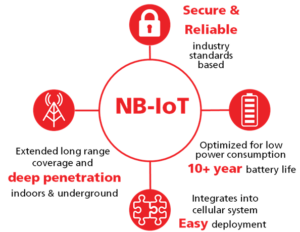 NB-IoT Key Features. Source: U-Blox[/caption]
Let’s discuss a bit about how each of these technologies work. Starting with NB-IoT, these devices work on a licensed frequency band with a standard developed by 3GPP, the people that make all the mobile telecommunications standards.
To get a device online and to begin sending data you’re going to need a sim for NB-IoT devices. Vodafone are currently the only NB-IoT connectivity provider in the UK.
You’ve now got your device and a SIM card, you just stick your SIM card in, and it works, right? Well, not quite. Before you get ahead of yourself, you are going to need to forward and decode that data. Without the relevant skills and time this can complex. Thanks to Symbius, our own in-house developed IoT middleware platform, we can simplify this process for you.
With Symbius you can forward your data to decode it and view it in one simple to use web application. It’s not necessarily an in-depth dashboard or meant for data storage, but with access to an API you can forward your decoded data. We even have a Node-Red Node to make getting your data just that bit easier.
The key components for getting started with NB-IoT are:
NB-IoT Key Features. Source: U-Blox[/caption]
Let’s discuss a bit about how each of these technologies work. Starting with NB-IoT, these devices work on a licensed frequency band with a standard developed by 3GPP, the people that make all the mobile telecommunications standards.
To get a device online and to begin sending data you’re going to need a sim for NB-IoT devices. Vodafone are currently the only NB-IoT connectivity provider in the UK.
You’ve now got your device and a SIM card, you just stick your SIM card in, and it works, right? Well, not quite. Before you get ahead of yourself, you are going to need to forward and decode that data. Without the relevant skills and time this can complex. Thanks to Symbius, our own in-house developed IoT middleware platform, we can simplify this process for you.
With Symbius you can forward your data to decode it and view it in one simple to use web application. It’s not necessarily an in-depth dashboard or meant for data storage, but with access to an API you can forward your decoded data. We even have a Node-Red Node to make getting your data just that bit easier.
The key components for getting started with NB-IoT are:
 LoRaWAN network architecture. Source: Semtech[/caption]
Moving onto LoRaWAN®, this is an unlicensed radio spectrum, that means it is cheaper but more likely to deal with interference (although LoRa is very good at dealing with interference). With LoRaWAN®, you also don’t have to worry about whether coverage is available in your area.The architecture that you’re going to be using for this is also specified by the LoRa Alliance who have plenty of resources and information on all things Lora.
To get your device up and running you are going to have some higher upfront costs than your NB-IoT counterpart. Starting off you need your device, no sim required, then you need a gateway. Think of the gateway as your internet router but with a much lower frequency and a much greater range. Depending on placement and the gateway you could get a range of up to 10km! The gateway will only have LoRaWAN® devices connected to it meaning it shouldn’t have any interference from other connected devices. At this point you’ve already bought an extra piece of hardware, and depending on what sort of gateway you’ve bought, and how it is set up, you will need to forward your payloads to a LoRaWAN® network server (LNS).
Now you have your devices connected to your gateway which is forwarding data to your LNS, but it’s likely your LNS isn’t decoding your data, so you are just seeing raw payloads. To make sense of this, you will have to forward the data again to be decoded to your chosen platform or dashboard.
LoRaWAN® has no shortage of different LNS’ and dashboards to choose from. If you are looking to do as little development as possible, from Kerlink’s Wanesy to LORIOT, and dashboards from Novacene to Kheiron, you have plenty of choice and support at every step.
If you are looking to go super cheap you can use The Things Networks (TTN) LNS for free, though you will probably find yourself looking for a bit more from your LNS the more you delve into LoRaWAN®.
To sum up, to get started with LoRaWAN®, you will need:
LoRaWAN network architecture. Source: Semtech[/caption]
Moving onto LoRaWAN®, this is an unlicensed radio spectrum, that means it is cheaper but more likely to deal with interference (although LoRa is very good at dealing with interference). With LoRaWAN®, you also don’t have to worry about whether coverage is available in your area.The architecture that you’re going to be using for this is also specified by the LoRa Alliance who have plenty of resources and information on all things Lora.
To get your device up and running you are going to have some higher upfront costs than your NB-IoT counterpart. Starting off you need your device, no sim required, then you need a gateway. Think of the gateway as your internet router but with a much lower frequency and a much greater range. Depending on placement and the gateway you could get a range of up to 10km! The gateway will only have LoRaWAN® devices connected to it meaning it shouldn’t have any interference from other connected devices. At this point you’ve already bought an extra piece of hardware, and depending on what sort of gateway you’ve bought, and how it is set up, you will need to forward your payloads to a LoRaWAN® network server (LNS).
Now you have your devices connected to your gateway which is forwarding data to your LNS, but it’s likely your LNS isn’t decoding your data, so you are just seeing raw payloads. To make sense of this, you will have to forward the data again to be decoded to your chosen platform or dashboard.
LoRaWAN® has no shortage of different LNS’ and dashboards to choose from. If you are looking to do as little development as possible, from Kerlink’s Wanesy to LORIOT, and dashboards from Novacene to Kheiron, you have plenty of choice and support at every step.
If you are looking to go super cheap you can use The Things Networks (TTN) LNS for free, though you will probably find yourself looking for a bit more from your LNS the more you delve into LoRaWAN®.
To sum up, to get started with LoRaWAN®, you will need:
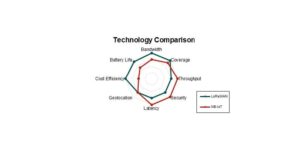 LoRaWAN - NB-IoT comparison. Source: ubidots[/caption]


Certifications